What is Asthma?
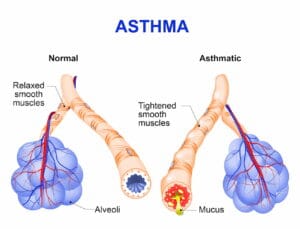
Asthma is chronic (long term) condition that affects the airways in the lungs. With asthma, the airways become inflamed and/or tight. When the airways are inflamed they produce mucus as a form of protection. Below is a visual of normal versus asthmatic airways in the lungs. At the end of the airways are little sacs of air called alveoli that are surrounded by little blood vessels called capillaries. This is where the transfer of air from the lungs to the blood takes place. The airways can be tight or inflamed for a variety of reasons, including allergies, airborne irritants, autoimmune response, nervous system or stress response, strenuous exercise, medications, changes in weather, hormones, or genetic pre-disposition.
There are several non-pharmaceutical techniques you can use to manage your asthma symptoms, including breathwork. Breathing Exercises for Adults with Asthma, provides a high level overview of the research available on breathwork and asthma.
How can breathwork help?
Improve breathing efficiency
Asthma has been linked to dysfunctional or non-optimal breathing. Dysfunctional breathing can be caused by one to many biochemical, biomechanical, or psychophysiological factors. Noticing how you are breathing is a great first step. As you become more aware of your breathing patterns and how they change throughout your day, you’ll gain insight into your nervous system and your physiological habits.
Identifying ways to make your breathing more efficient can help reduce the frequency of your asthma symptoms. While you need to take into account your breathing history and habits, typically a soft, slow, and steady breath with a brief pause after the exhale tends to be an efficient breathing pattern.
When you’re at rest, your breath will primarily be located in your lower ribs and abdomen area; your shoulders, abdominal area, and back will be relaxed. As you increase your activity, you’ll feel your lower ribs and middle chest expand as your breath gets larger to meet your metabolic needs. A more efficient breathing pattern tends to reduce overall stress, putting less strain on your body when you’re at rest or when you’re working out. Also, a more efficient breathing pattern is more relaxing for the body, making it easier to help the body recover, regulate, and heal itself.
Improve your resiliency by breathing through your nose
In general, breathing through your nose while asleep and while doing moderate physical activity will improve your breathing efficiency, increase your comfort with carbon dioxide, and help with asthma symptoms. When you breathe through your nose, you tend to better match your respiratory performance with your metabolic needs. When we mouth breathe, we’re more likely to enter a mild state of hyperventilation, or overbreathing. Nose breathing can also help because it tends to encourage you to breathe lower into your ribs, rather than the upper chest.
Luxuriate in the recovery between breath cycles.
Ideally, you would pause briefly after exhaling before starting your next inhale. During this brief pause, your body recovers from the work of breathing and has a brief rest before the next inhalation or breath cycle begins. In general, focusing on exhaling and enjoying a brief pause before inhaling, can also help reduce the likelihood of asthma attacks. Many asthmatics tends to focus on inhaling more than exhaling. Sometimes asthmatics will start to inhale again before the exhale is complete, leading to overbreathing. Overtime this can lead to overinflation of the lungs and respiratory muscle tone loss. It can be helpful to practice on exhaling fully and taking a brief pause before the inhales.
Breathing exercises
Many breathing techniques can help you improve your self-regulation tools, reduce stress, breathe more efficiently, and manage your asthma. Below are two beginner breathing exercises to try. Please reach out to Nicole if you have any questions or want to meet individually.
Mini-breath holds after you exhale, before you inhale
- Breathe in as you normally would
- Breathe out as you normally would
- Hold your breath out for 3-7 seconds
- Relax and then breath in again and repeat the entire process 10 times.
SHH Breath
- Take a normal breathe in
- Make the “SHH” sound (the same sound you would make it you were trying to get someone to be quiet) as you exhale.
- Keep making the “SHH” sound as long as you can. You want to completely exhale all the air you can, more than you normally would.
- After you have completely exhaled all your air and can no longer make the “SHH” sound. Relax and take a normal breathe in and out.
- Repeat 3 – 10 times.